1689072975.png)
CUET 2026 Preparation Strategy: What to Study First (NCERT Plan + Mock Test Timeline)
January 16, 2026
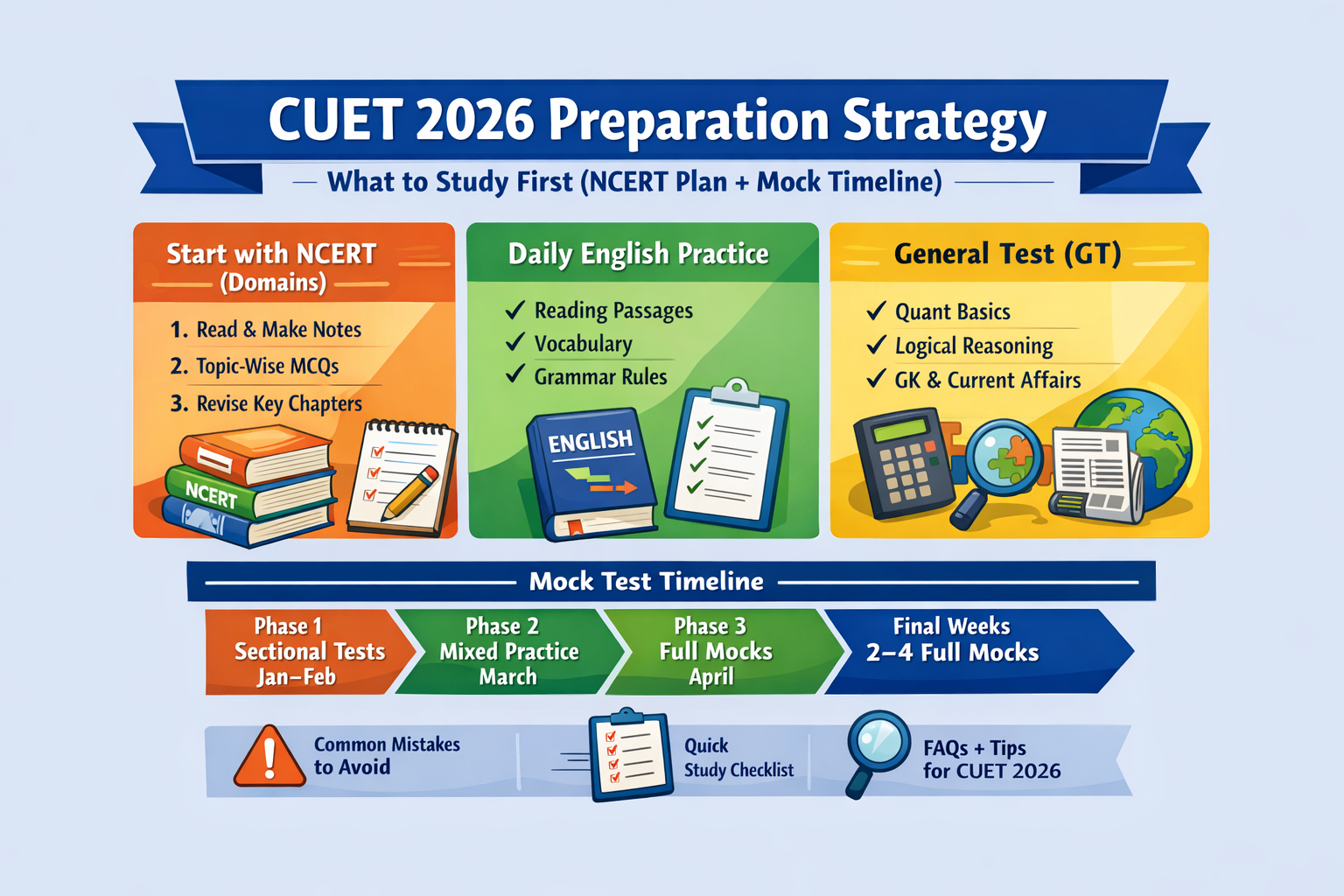
When it comes to CUET 2026, the biggest difference between an average score and a top score is rarely “studying more”. It’s usually studying in the right order: first building your NCERT base, then converting it into MCQ accuracy, and finally sharpening speed and selection with mocks.
This guide gives you a clean, practical CUET 2026 preparation strategy that answers one common question: “What should I study first?” You’ll get an NCERT-first plan, a practice workflow that actually improves marks, and a mock test timeline you can follow from January 2026 onwards.
CUET 2026 Exam Snapshot
- Domain Subjects: Your chosen subjects (based on the course/college requirements).
- Language (often English): Reading comprehension, grammar basics, vocabulary, and usage.
- General Test (GT): Quantitative aptitude, logical reasoning, general knowledge, and current affairs (as applicable).
Your score improves fastest when you work on three levers: (1) concept clarity, (2) accuracy, and (3) smart question selection under time. That’s why your sequence matters.
What to Study First for CUET 2026
1) Start With Domain Subjects (NCERT First, Always)
If you’re serious about CUET 2026, start with your Domain subjects and make NCERT your first resource. NCERT is not “basic”; it’s the foundation that gives you the language, concepts, and patterns CUET questions love.
- Week 1–2: Pick foundational chapters (core definitions, base concepts).
- Week 3–6: Cover high-weight chapters and commonly tested topics.
- Week 7 onwards: Start revisiting earlier chapters through mixed MCQs and short notes.
Rule: For every chapter you read, you must do topic-wise MCQs within 24–48 hours. This is how “reading” becomes “scoring”.
2) Parallel Track: English (or Your Language Paper)
English shouldn’t be postponed. You don’t need long hours here, but you do need consistency because language improves through repetition.
- Daily (20–30 mins): 1 reading passage + 8–12 questions.
- Daily (10 mins): 8–12 new words + revision of old words.
- Alternate days (15 mins): grammar + error spotting style questions.
Keep English light but daily. Over time, your speed and comprehension build naturally, which helps not just English but also GT reading-based questions.
3) General Test (GT): Start Small, Stay Regular
GT becomes easy to manage when you stop trying to “finish everything” in one month. Start with the basics and keep it steady from January 2026.
- Quant basics: percentages, ratios, averages, profit & loss, time & work, time-speed-distance, number basics, DI fundamentals.
- Logical reasoning: series, analogy, direction, coding-decoding, syllogisms (basic), seating arrangements (gradually).
- GK/CA: 10–15 mins/day. Focus on major events + static basics relevant to your level.
The NCERT-First Plan (How to Use NCERT Properly)
Many students “complete NCERT” but still lose marks because they read passively. Here’s a simple 3-pass method that works for CUET 2026.
Pass 1: Read for Concepts (No pressure)
- Read with the aim of understanding meanings, definitions, and examples.
- Mark only the lines that feel “exam-like” (definitions, lists, comparisons, key terms).
Pass 2: Convert to Notes (One page per chapter)
- Create a 1-page chapter sheet: key terms, formulas, definitions, common traps, and 3–5 quick examples.
- Use simple headings like “Key Concepts”, “Must-Remember”, “Common Confusions”.
Pass 3: MCQs + Error Fixing
- Do topic-wise MCQs right after the chapter.
- Every wrong question must be tagged as:
- Concept gap (didn’t know)
- Silly mistake (knew but misread/overthought)
- Time pressure (slow method, needs shortcut or practice)
This NCERT-first process is the backbone of a strong CUET 2026 preparation strategy because it creates both knowledge and exam readiness.
Practice Strategy That Actually Improves Marks
For CUET 2026, practice should follow a ladder. Skipping steps causes low accuracy and poor retention.
- Topic-wise MCQs (after each NCERT chapter)
- Mixed practice (combine 3–4 chapters)
- Sectional tests (Domain/English/GT separately)
- Full mocks (exam simulation + strategy)
Non-negotiable: Maintain a simple error log. It can be a notebook or a sheet. Write:
- Question topic
- Why did you get it wrong
- Correct concept/rule
- One-line takeaway (“next time I will…”)
CUET 2026 Mock Test Timeline
Mocks should start earlier than most students think, but not as “full mocks” immediately. Start with sectional tests and build up.
| Timeline | What to Focus On | Tests & Mocks (Recommended) |
|---|---|---|
| January 2026 – February 2026 | NCERT base + topic-wise MCQs + steady English/GT routine | 1–2 sectional tests/week (start small) + 1 analysis session |
| March 2026 | Mixed practice (3–4 chapters together) + speed improvement | 2 sectional tests/week + 1 mixed mini-mock/week |
| April 2026 | Revision cycle + weak-area repair + smarter selection | 1–2 full mocks/week + 2 sectional tests/week (as needed) |
| Last 6–8 weeks before the CUET 2026 exam window | Exam temperament + time management + high-frequency revision | 2–4 full mocks/week (depending on availability) + strict analysis |
How to analyse a mock (quick method):
- Accuracy check: Which topics are dropping your score?
- Time map: Where did you spend too long?
- Selection strategy: Did you pick hard questions early and lose time?
- Fix list: 5 actions for next mock (not 50).
Weekly Schedule Templates (Pick One)
Choose a schedule based on your daily available time. Keep it realistic and repeatable.
| Daily Time | Domains | English | GT | Tests |
|---|---|---|---|---|
| 2 hours/day | 70 mins NCERT + MCQs | 25 mins RC + vocab | 25 mins Quant/LR | 1 sectional test/week + analysis |
| 3–4 hours/day | 120 mins NCERT + mixed practice | 35 mins RC + grammar | 45 mins Quant/LR + 10 mins GK/CA | 2 sectional tests/week + 1 mini-mock |
| 5–6 hours/day (dropper) | 3 hours (concept + MCQs + revision) | 45 mins | 60–75 mins | 1–2 tests mid-week + 1 full mock/week (then increase) |
Weekly testing rhythm (easy to follow):
- Mon–Fri: Concept + MCQs (Domains) + short English/GT
- Saturday: Sectional test + deep analysis
- Sunday: Mixed practice + revision of weak chapters
Common Mistakes to Avoid in CUET 2026 Preparation
- Starting mocks too late: start sectional tests early; build up gradually.
- Skipping analysis: a mock without analysis is just a timed worksheet.
- Too many resources: NCERT + a good question bank + tests are enough for most students.
- Random GK overload: keep GK/CA short and consistent instead of binge studying.
- Ignoring weak chapters: weak areas don’t disappear; they compound.
Quick Checklist: What to Do First (CUET 2026)
7-Day Starter Checklist
- Finalise your Domain subjects + confirm what your target courses require.
- Pick 2 foundational chapters per Domain subject and start NCERT Pass 1.
- Create your 1-page notes format and use it for every chapter.
- Start English daily: 1 RC passage + vocab.
- Start GT on alternate days: basics of Quant/LR.
- Do topic-wise MCQs for the chapters you studied.
- Book one fixed day for test + analysis every week.
30-Day Milestones
- At least 25–35% NCERT coverage across your Domain subjects (depending on the number of subjects).
- Minimum 4–6 sectional tests attempted + analysed.
- English routine stabilised (RC speed improving, vocab revision working).
- GT basics started (you should feel less “blank” when you see questions).
Final Word
If you start CUET 2026 preparation from January 2026 with a clean NCERT-first order, you’ll feel in control well before the exam window. Keep your resources limited, test consistently, and analyse honestly. That’s the strategy that converts effort into marks.
Next step: If you share your stream + Domain subjects (for example: Accounts, Business Studies, Economics, English, GT), I can create a chapter order + 8-week target plan tailored to your exact combination.
Frequently Asked Questions
What is the best order to study for CUET 2026?

Is NCERT enough for CUET 2026 domain subjects?
When should I start mocks for CUET 2026?
How many hours are enough for CUET 2026 preparation?
How do I balance domains with English and GT?

Admin
Senior Content Writer
SHARE