1689072975.png)
CAT Syllabus 2027 PDF Download Section-Wise Topics, Exam Pattern, Marking Scheme, and Preparation Strategy
June 3, 2026
Overview: If you are planning to appear for CAT 2027, understanding the CAT syllabus is the first step toward a smart preparation plan. The CAT exam does not release a fixed chapter-wise official syllabus in the same way many board or university exams do, but its structure has remained broadly stable over the years: three sections Verbal Ability & Reading Comprehension (VARC), Data Interpretation & Logical Reasoning (DILR), and Quantitative Aptitude (QA).
For beginners, the best way to understand the CAT 2027 syllabus is not as a random list of topics, but as a skill map. CAT tests your reading ability, logical reasoning, data handling, and quantitative problem-solving under time pressure. That is why the right approach is to learn the concepts, identify high-frequency topics, and then practise with sectionals and mocks.
Quick Overview of CAT Syllabus 2027
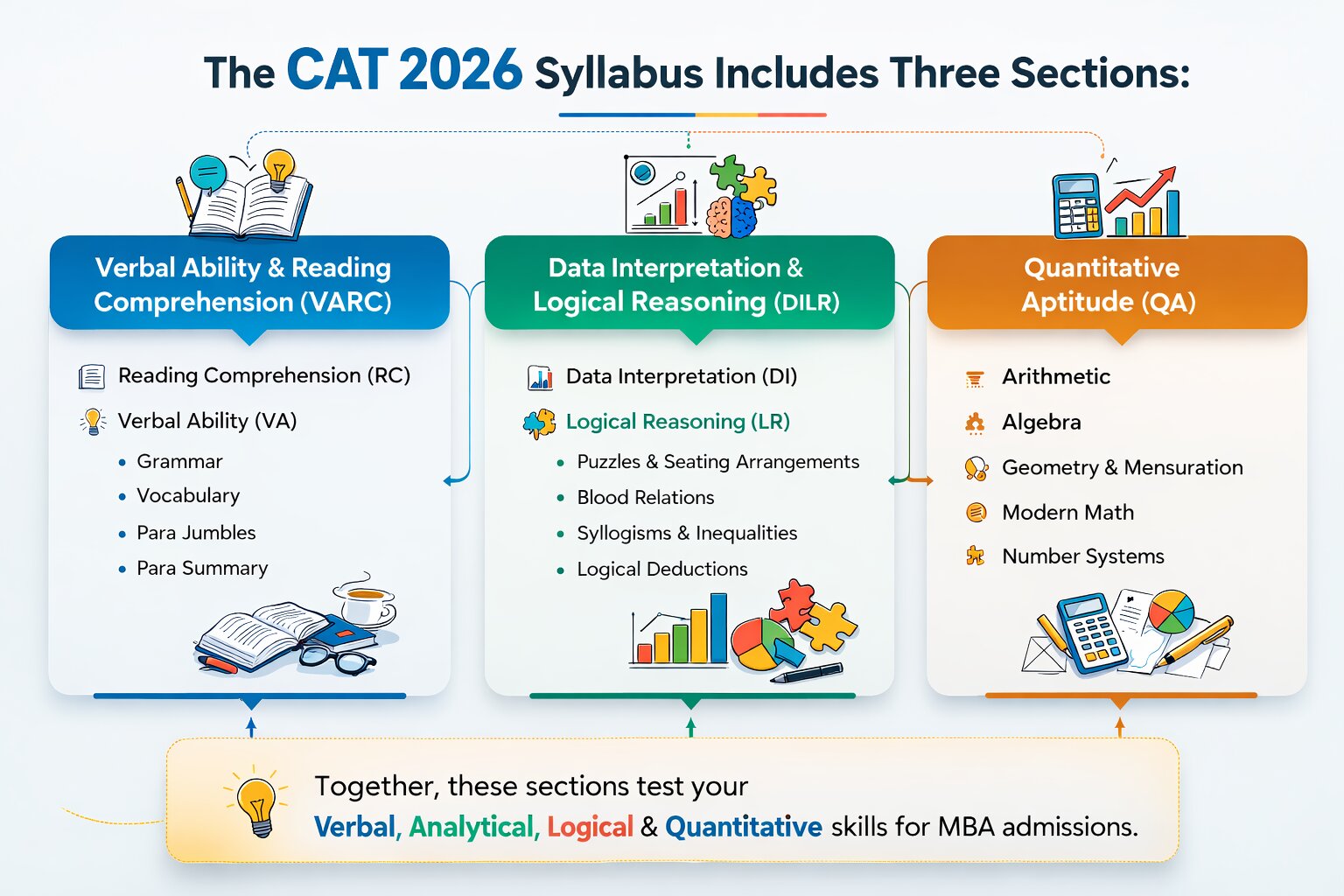
The CAT syllabus is broadly divided into the following three sections: VARC, DILR, and QA. This three-section format has stayed consistent over the years and continues to define CAT preparation.
CAT 2027 Exam Snapshot
| Particulars | Details |
|---|---|
| Exam Name | Common Admission Test (CAT) |
| Expected Mode | Computer-Based Test |
| Expected Sections | VARC, DILR, QA |
| Expected Total Questions | 68 |
| Expected Total Duration | 120 minutes |
| Sectional Time Limit | 40 minutes each |
| Marking Scheme | +3 for correct answer, -1 for incorrect MCQ, no negative marking for TITA/non-MCQ |
| Expected Total Marks | 204 |
What is the CAT syllabus for 2027?
The CAT 2027 syllabus includes three sections: Verbal Ability & Reading Comprehension (VARC), Data Interpretation & Logical Reasoning (DILR), and Quantitative Aptitude (QA).
What You Should Know About the CAT Syllabus 2027
- The CAT syllabus is not officially published as a rigid chapter list, so you prepare from previous year trends and current pattern analysis.
- The exam focuses more on application and decision-making than on direct theory-based questions.
- The CAT syllabus PDF you download from coaching sites or education portals is usually a compiled reference document, not a formal chapter list issued by IIMs.
That means your preparation should be concept-driven and test-oriented.
| CAT Exam Analysis | CAT PYQs | CAT 2020 Question Paper |
| CAT 2026 Question Paper | CAT 2021 Question Paper | CAT 2022 Question Paper |
| CAT 2025 Question Paper | CAT 2024 Question Paper | CAT 2023 Question Paper |
Subject-Wise CAT Syllabus 2027
Below is the detailed subject-wise breakdown of the CAT syllabus for all three sections.
1) VARC Syllabus for CAT 2027
The Verbal Ability and Reading Comprehension (VARC) section checks whether you can read dense passages, understand arguments, interpret tone, identify central ideas, and handle language-based logic. Reading Comprehension typically carries the biggest share within VARC in recent CAT papers, while verbal ability questions test accuracy and interpretation.
Important Topics in CAT VARC
| Area | Topics Covered |
|---|---|
| Reading Comprehension | Main idea, inference, tone of author, fact vs opinion, paragraph meaning, title selection, argument-based questions |
| Para-based Verbal Ability | Para jumbles, para summary, odd one out, paragraph completion |
| Language Skills | Grammar basics, vocabulary in context, sentence structure, contextual usage |
| Critical Reading | Assumption, conclusion, strengthening/weakening arguments, logical flow |
CAT VARC Preparation Strategy
- Read every day for 30 to 45 minutes from editorials, essays, business articles, philosophy, science, and social science pieces.
- Focus on understanding structure: introduction, argument, evidence, and conclusion.
- Practise para jumbles and summaries regularly because these are concept-heavy but scoring once mastered.
- Do not overfocus on memorising vocabulary lists. CAT tests contextual understanding more than direct word meanings.
- After each RC set, analyse why each wrong option is wrong. This is where real improvement happens.
Beginner Tip for VARC
A common mistake is reading fast without processing the argument. In CAT, comprehension beats speed. Build speed only after your understanding improves.
2) DILR Syllabus for CAT 2027
The Data Interpretation & Logical Reasoning (DILR) section is often seen as the most unpredictable part of the CAT syllabus. It tests your ability to interpret data, identify patterns, build logical structures, and solve multi-step sets. The difficulty usually comes less from formulas and more from set selection and pressure handling.
Important Topics in CAT DILR
| Area | Topics Covered |
|---|---|
| Data Interpretation | Tables, bar graphs, line graphs, pie charts, caselets, mixed graphs, data comparison |
| Logical Reasoning | Arrangements, seating arrangement, puzzles, games and tournaments, schedules, routes and networks |
| Set-based Reasoning | Grouping, distribution, selection, ordering, binary logic, matching sets |
| Calculation Support | Ratios, percentages, averages, approximation, data sufficiency style interpretation |
CAT DILR Preparation Strategy
- Practise full sets instead of standalone questions. CAT DILR is about solving sets efficiently.
- Develop the habit of scanning all sets first and choosing the most doable ones.
- Maintain a notebook of standard puzzle frameworks such as linear arrangement, circular arrangement, matrix arrangement, and distribution.
- Improve calculation speed for percentages, fractions, averages, and ratios because DI becomes easier with fast approximation.
- After every mock, review not just the sets you solved, but also the sets you should have chosen.
Beginner Tip for DILR
In DILR, selection is strategy. Many students lose marks not because they cannot solve, but because they start with the wrong set.
3) QA Syllabus for CAT 2027
The Quantitative Aptitude (QA) section in the CAT syllabus usually tests Class 8 to 10 level maths concepts, but at a much higher level of application. Arithmetic and algebra usually receive strong attention in most preparation plans, while geometry, number systems, and modern maths also remain important depending on the year.
Important Topics in CAT QA
| Major Unit | Topics Covered |
|---|---|
| Arithmetic | Percentages, profit and loss, ratio and proportion, averages, mixtures and alligation, time and work, time-speed-distance, simple and compound interest |
| Algebra | Linear equations, quadratic equations, inequalities, functions, logarithms, surds and indices, progressions |
| Geometry & Mensuration | Lines and angles, triangles, circles, quadrilaterals, polygons, coordinate geometry basics, area, volume, mensuration |
| Number System | Divisibility, factors and multiples, remainders, HCF-LCM, cyclicity, units digit |
| Modern Maths | Permutation and combination, probability, set theory, basic counting principles |
| Miscellaneous | Partnership, variation, sequence-based arithmetic applications |
CAT QA Preparation Strategy
- Start with arithmetic because it creates a strong base and appears heavily in CAT preparation plans.
- Move next to algebra, especially equations, inequalities, and functions.
- Keep a formula and concept register, but do not rely only on it. CAT asks application-based questions.
- Solve questions topic-wise first, then sectional mixed tests, then mock-based practice.
- Track whether your issue is concept, speed, or accuracy. Your study plan should depend on that diagnosis.
Beginner Tip for QA
Do not be scared by the maths tag. CAT QA rewards clarity and method more than advanced mathematics.
CAT 2027 Syllabus: Section-Wise Summary Table
| Section | Expected Questions | Key Focus Areas |
|---|---|---|
| VARC | 24 | RC, para jumbles, para summary, odd one out, critical reading |
| DILR | 22 | Charts, tables, caselets, arrangements, distribution, logic sets |
| QA | 22 | Arithmetic, algebra, geometry, number system, modern maths |
CAT 2027 Exam Pattern and Marking Scheme
Aspirants should not study the CAT syllabus in isolation awareness is equally important because the exam is heavily time-bound.
Latest Expected CAT Exam Pattern
| Feature | Expected CAT 2027 Pattern |
|---|---|
| Test Mode | Computer-based |
| Number of Sections | 3 |
| Section Order | Fixed |
| Time Per Section | 40 minutes |
| Total Time | 120 minutes |
| Question Type | MCQ and TITA / Non-MCQ |
| Negative Marking | Only for wrong MCQs |
| Marks Per Correct Answer | +3 |
Trends from Previous Years
The biggest trend in recent CAT exams is that the paper has stayed stable in overall structure, but difficulty and set selection continue to vary. Recent exam patterns suggest that CAT has been operating with 68 questions in the current format, and the section mix remains broadly similar.
- Stable three-section structure: VARC, DILR, and QA continue to define the CAT syllabus and pattern.
- Reading-heavy VARC: RC remains the dominant component.
- DILR remains selection-based: Not every set is intended to be solved.
- QA rewards fundamentals: Arithmetic and algebra continue to be central in most prep analyses.
- Mock analysis matters more than volume: Serious improvement comes from review, not just attempts.
How to Prepare the CAT Syllabus Section-Wise
Preparing for CAT becomes much easier when you divide the syllabus section-wise and follow a proper study plan for each part using the right CAT study material. The exam mainly has three sections: VARC, DILR, and QA. Each section requires a different preparation strategy and set of CAT study material to build the necessary skills.
The table below gives a quick understanding..
| Section | Full Form | What It Tests | Preparation Focus |
|---|---|---|---|
| VARC | Verbal Ability and Reading Comprehension | Reading, comprehension, vocabulary in context, logic of language | Reading habit, RC practice, verbal question practice |
| DILR | Data Interpretation and Logical Reasoning | Logical thinking, data handling, puzzle-solving | Set practice, pattern recognition, timed selection |
| QA | Quantitative Aptitude | Maths concepts, calculations, application | Concept clarity, chapter-wise practice, revision |
1. CAT VARC Study Plan
VARC is one of the most scoring sections for students who build consistency. It is not just about English grammar. It is more about understanding what the passage says, what the author means, and how ideas are connected.
Important Topics in VARC
| Topic | What to Focus On |
|---|---|
| Reading Comprehension | Main idea, tone, inference, assumption, fact vs opinion |
| Para Jumbles | Logical sequence of sentences |
| Para Summary | Central idea of a paragraph |
| Odd One Out | Sentence flow and coherence |
| Sentence Insertion | Placement of a sentence in context |
How to Prepare CAT VARC
- Read editorials, magazines, and long-form articles daily.
- Start with 3 to 4 Reading Comprehension passages every week.
- Increase practice gradually and move to timed RC solving.
- Practise para jumbles, para summary, and odd-one-out regularly.
- Maintain an error log for inference-based and summary-based mistakes.
- Analyse why the correct option is right and why others are wrong.
Weekly CAT VARC Plan
| Activity | Frequency |
|---|---|
| Newspaper/editorial reading | Daily |
| RC passage practice | 3 to 4 passages weekly initially |
| Verbal Ability question practice | 3 to 4 days a week |
| Error log revision | Weekly |
| Sectional test | Once basics improve |
CAT VARC Preparation Tips
| Do's | Don'ts |
|---|---|
| Read from diverse topics like philosophy, science, economics | Do not rely only on vocabulary memorisation |
| Focus on passage logic and author tone | Do not rush through passages |
| Track recurring mistakes | Do not skip analysis after practice |
| Build reading stamina | Do not practise only one type of RC |
2. CAT DILR Study Plan
DILR is often the most unpredictable section in CAT. Success in this section depends on practice, patience, and smart set selection. It is not enough to know logic. You must know which set to attempt and which one to leave.
Important Topics in DILR
| Topic | What to Focus On |
|---|---|
| Tables and Charts | Reading and interpreting data |
| Arrangements | Linear, circular, and complex seating |
| Games and Tournaments | Ranking, scoring, conditional logic |
| Grouping and Distribution | Allocation-based logic sets |
| Venn Diagrams | Overlapping sets and classification |
| Caselets | Mixed data and logical interpretation |
| Routes and Networks | Path-based logical reasoning |
| Binary Logic | Yes/No, True/False patterns |
How to Prepare CAT DILR
- Begin with basic puzzle and arrangement sets.
- Practise at least 4 to 5 sets per week initially.
- Cover a variety of set types instead of repeating one model.
- Learn diagrams, tables, and structured note-making while solving.
- Move to timed solving after basic familiarity.
- Learn mock-based set selection strategy.
Weekly CAT DILR Plan
| Activity | Frequency |
|---|---|
| Basic set practice | 4 to 5 sets weekly initially |
| Variety-based mixed practice | 3 to 4 days a week |
| Timed practice | After basics are complete |
| Previous mock set analysis | Weekly |
| Sectional DILR test | Once confidence improves |
CAT DILR Preparation Tips
| Do's | Don'ts |
|---|---|
| Practise different set types | Do not solve only familiar sets |
| Learn when to leave a difficult set | Do not spend too much time on one set |
| Focus on structure and presentation | Do not solve mentally without organising data |
| Analyse alternative solving methods | Do not ignore mock analysis |
3. CAT QA Study Plan
Quantitative Aptitude needs concept clarity first and speed later. Many students make the mistake of directly solving advanced CAT questions without understanding the basics. QA becomes manageable when you prepare chapter-wise and revise regularly.
Important Topics in QA
| Area | Topics Included |
|---|---|
| Arithmetic | Percentages, Profit and Loss, Ratio, Average, Time and Work, Time Speed Distance, SI-CI |
| Algebra | Linear equations, Quadratic equations, Inequalities, Functions, Logs |
| Geometry | Lines, Angles, Triangles, Circles, Mensuration, Coordinate Geometry |
| Number Systems | Divisibility, Remainders, Factors, LCM-HCF, Base Systems |
| Modern Maths | Permutation and Combination, Probability, Set Theory, Progressions |
How to Prepare CAT QA
- Start with Arithmetic because it forms the base for many CAT questions.
- Move to Algebra after arithmetic fundamentals are clear.
- Cover Geometry and Number Systems next.
- Keep Modern Maths for later once basics are strong.
- Solve chapter-wise questions before mixed-topic sets.
- Maintain a formula notebook and mistake notebook.
- Shift to sectional tests and mixed practice gradually.
Suggested Topic Order for QA
| Order | Topic |
|---|---|
| 1 | Arithmetic |
| 2 | Algebra |
| 3 | Geometry |
| 4 | Number Systems |
| 5 | Modern Maths |
Weekly CAT QA Plan
| Activity | Frequency |
|---|---|
| Concept learning | Daily |
| Chapter-wise practice | 4 to 5 days a week |
| Formula revision | Daily or alternate days |
| Mixed practice | After chapter completion |
| Sectional test | Weekly after foundation stage |
CAT QA Preparation Tips
| Do's | Don'ts |
|---|---|
| Build concepts chapter-wise | Do not jump directly to difficult mixed questions |
| Practise calculations regularly | Do not depend completely on shortcuts |
| Revise formulas often | Do not leave weak chapters untouched |
| Analyse mistakes topic-wise | Do not study QA without written practice |
4. Best Section-Wise Preparation Strategy for CAT
The right order of preparation helps you stay consistent and avoid confusion.
| Phase | What to Do |
|---|---|
| Phase 1 | Build reading habit for VARC, basics of Arithmetic for QA, and basic puzzle exposure for DILR |
| Phase 2 | Start chapter-wise practice and topic-wise strengthening |
| Phase 3 | Begin sectional tests for each section |
| Phase 4 | Start full-length mocks |
| Phase 5 | Analyse mocks deeply and improve weak areas |
5. Comparison of Preparation Approach for All Three Sections
| Section | First Priority | Second Priority | Final Stage |
|---|---|---|---|
| VARC | Reading habit | RC and verbal practice | Timed sectional tests |
| DILR | Basic set understanding | Variety and set selection | Timed mocks and strategy |
| QA | Concept building | Chapter-wise problem solving | Mixed practice and speed |
6. Common Mistakes to Avoid
| Mistake | Why It Hurts Preparation |
|---|---|
| Starting mocks too early | Weak basics lead to poor performance and low confidence |
| Ignoring RC practice | VARC score drops because RC dominates the section |
| Solving only easy DILR sets | Real CAT sets become difficult to handle |
| Jumping to advanced QA too soon | Concepts remain weak and accuracy suffers |
| Not maintaining an error log | Same mistakes get repeated |
| Not analysing tests | Improvement becomes very slow |
7. Final Section-Wise Advice
| Section | Final Advice |
|---|---|
| VARC | Read daily and focus on understanding, not just speed |
| DILR | Practise diverse sets and improve set selection |
| QA | Master concepts first, then improve speed and accuracy |
The best way to prepare the CAT syllabus section-wise is to follow a balanced plan of concept building, regular practice, timed solving, and mistake analysis. If you prepare each section with the right method, CAT becomes much more manageable.
How to Download CAT Syllabus PDF
There is usually no single official IIM-issued detailed chapter list called CAT syllabus PDF, but aspirants commonly use compiled syllabus PDFs and topic lists from recognised exam-prep or education portals for revision. A practical way to build your own CAT syllabus PDF reference is:
- Open the official CAT website for the latest exam notices and mock-test updates.
- Note the current exam pattern and section structure.
- Use a reliable syllabus page from a recognised education platform for topic mapping.
- Save that page as PDF or create your own one-page revision sheet section-wise.
- Keep updating it as official CAT 2027 announcements are released.
Best Way to Use the CAT Syllabus for Preparation
The CAT syllabus can seem vast and intimidating, but a structured approach makes preparation manageable and effective. By breaking down each section Quantitative Ability, Data Interpretation & Logical Reasoning, and Verbal Ability & Reading Comprehension—into focused topics and strategies, candidates can systematically build their skills while tracking progress.
Regular practice, mock tests, and timely revision, combined with shortcut techniques and error analysis, ensure consistent improvement and boost confidence for the exam day.
| Section | Key Topics | Preparation Strategy | Tips & Techniques |
|---|---|---|---|
| Quantitative Ability (QA) | Arithmetic, Algebra, Geometry, Number Systems, Probability & Permutations, Mensuration | 1. Start with basics and formulae. 2. Practice topic-wise questions daily. 3. Solve previous CAT papers. | Focus on speed and accuracy. Use shortcuts and mental math. Analyze mistakes to avoid repetition. |
| Data Interpretation & Logical Reasoning (DILR) | Tables, Graphs, Charts, Caselets, Puzzles, Seating Arrangements, Arrangements & Series | 1. Understand different DI types. 2. Solve puzzles regularly. 3. Attempt mocks under time constraints. | Learn to identify easy sets first. Work on elimination strategies. Time management is crucial. |
| Verbal Ability & Reading Comprehension (VARC) | Reading Comprehension, Para Jumbles, Para Summary, Sentence Correction, Vocabulary | 1. Read newspapers, editorials, and novels. 2. Practice RCs daily. 3. Attempt verbal exercises. | Focus on comprehension over speed initially. Improve vocabulary contextually. Summarize passages mentally. |
| Mock Tests & Analysis | Full-length CAT Mocks | 1. Take sectional & full-length mocks weekly. 2. Analyze performance critically. 3. Identify weak areas and revise. | Maintain a log of errors. Adapt time allocation per section based on strengths. |
| Revision & Shortcuts | Formulae, Key Concepts, Common Traps | 1. Prepare a concise notes booklet. 2. Revise weekly. 3. Memorize shortcuts for QA & DILR. | Focus on recurring question patterns. Keep revising to reinforce memory. |
Conclusion
The CAT syllabus may look wide at first, but it becomes manageable once you break it into sections and study with a plan. For CAT 2027, the safest approach is to prepare around the current three-section format of VARC, DILR, and QA, stay updated with official CAT notices, and practise with a strong mix of concepts, sectionals, and mocks.
If you are a beginner, do not try to finish everything in one go. Build momentum one section at a time. Once your fundamentals are in place, the CAT syllabus PDF becomes less of a checklist and more of a roadmap.
Frequently Asked Questions
Is the CAT syllabus officially released by IIM?

What topics are included in CAT VARC?
What topics are included in CAT DILR?
Which section has the highest weightage in the CAT 2027 syllabus?
Is Reading Comprehension important in the CAT exam syllabus?
Does the CAT exam syllabus include grammar?

Admin
Senior Content Writer
SHARE